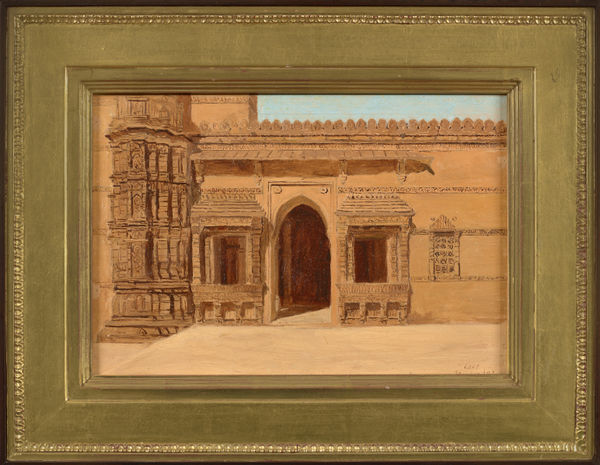
Lockwood De Forest, Rani Rupamati's Mosque, Ahmedabad, (1893): The Friday Find

27 February - 6 March 2026
  • This week we have a remarkable painting depicting a historical monument in Ahmedabad, by Lockwood de Forest (1850-1932) an American...

    This week we have a remarkable painting depicting a historical monument in Ahmedabad, by Lockwood de Forest (1850-1932) an American painter, interior designer and furniture designer. De Forest was a key figure in the Aesthetic Movement, and introduced Indian craft revival to Gilded Age America.


    You can read about de Forest’s early life and career here, but today, we’re focussing on the part in India…  In November 1880 de Forest married Meta Kemble (1852-1933), a du Pont, setting off for India, a honeymoon and business trip combined.

  • During what became a two-year trip, de Forest collected furniture, jewellery and textiles as he and his wife travelled through Bombay (Mumbai), Surat, Baroda (Vadodara), Ahmadabad, Agra, Delhi, Amritsar, Lahore, and Srinagar. In Ahmadabad, de Forest met Muggunbhai Hutheesing, a philanthropist with an interest in the arts, and together the two men opened the Ahmadabad Woodcarving Company. This studio took commissions from some of the most prominent Americans of the age including Ogden Goelet, Henry Havemeyer, Mark Twain, and Cornelius Vanderbilt II.


    After Associated Artists closed in 1882, de Forest opened his own design business in New York with a lavish showroom at 9 East 17th Street. In addition to managing the design, production and import of goods, De Forest continued to design his own furnishings and architectural ornaments.

  • In 1887, he had a house built in New York at 7 East 10th Street, with carved decorative external features...
    Source: Tom Miller

    In 1887, he had a house built in New York at 7 East 10th Street, with carved decorative external features and richly appointed interiors.


    The De Forest House was unique. “In all the United States, there is not another house like this,” said The Times.

    On the second floor, a huge landing opened onto the parlour on one side and the dining room on the other. The windows of the dining room were framed in intricate lattice-work and the ceiling was supported by carved teakwood beams forming squares in which were carved rosettes.

    The ceiling of the parlour was stencilled brass with a carved frieze. Throughout the house were piles of Oriental rugs, chests and other carved furniture, porcelains and brass.

  • This small-scale oil painting on paper, laid down on canvas depicts Rani Rupamati’s Mosque, also known as Mirzapur Queen’s Mosque in Ahmedabad. It is a Sufi mosque, and dagah complex in Mirzapur, in the state of Gujrat. The mosque was built by Mahmud Begada, probably in the latter years (1430-1440) of Ahmad Shah I's reign. It blends Hindu and Muslim architecture and is named after Rani Rupamati whom Mahmud Begada married after death of Qutubuddin. 


    These two photographs show the exact area painted by De Forest, published in Architecture at Ahmedabad, the Capital of Goozerat, photographed by Colonel Biggs, published in 1866, 25 years before De Forest’s visit. In the 1879 Gazetteer of the Bombay Presidency, the writer mentions the area previously being overun by tigers, and how in 1840 one was shot within the Queen's Moseque itself...

  • Lockwood de Forest, Rani Rupamati's Mosque, Ahmedabad, 1893

    Lockwood de Forest

    Rani Rupamati's Mosque, Ahmedabad, 1893
    Fact Sheet:


    Lockwood de Forest 1850-1932

    Rani Rupamati's Mosque, Ahmedabad, (1893)

    Signed and dated 'L de F. Mar 18 / 93' lower right

    Oil on paper laid down on canvas

    25.1 x 36.5 cm
    9 7/8 x 14 3/8 in


    Provenance

    Private US Collection