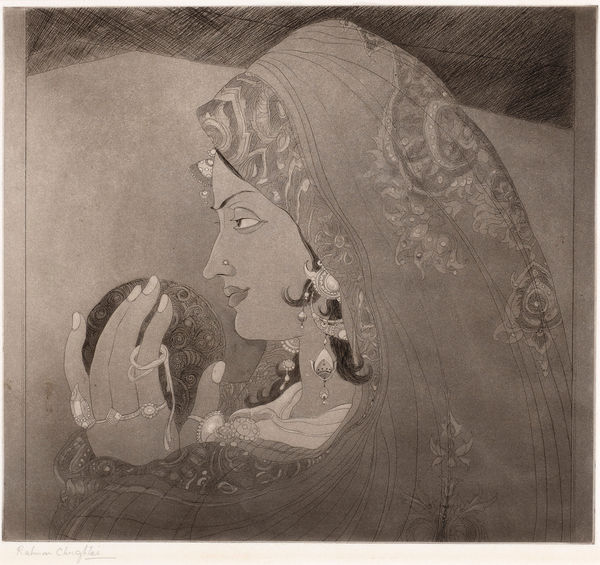
"His lineal genius and skill finds remarkable expression in his etchings. Etching is a purely graphic art to be executed through line alone. And Chughtai commands a mastery of line…… To the Westerners, whose technique he has borrowed, but made quite his own, he would seem to be a born etcher."
- Malik Shams, quoted in a 1959 exhibition catalogue
-
Abdur Rahman Chughtai was born in Lahore (then India). He studied at Mayo School of Art and there developed a style that combined the neatness of Mughal and Persian miniatures with the delicacy of Japanese ink paintings. In his work, Chughtai often depicted sentimental and poetic scenes where characters typically personified places and moods. His painting style developed along the similar lines to that of the Bengal school of art which flourished between 1905 and 1920.
In 1947, after India's partition, Chughtai moved to Pakistan where he designed the nation's first postal stamp as well as the logo for Radio Pakistan and the Pakistan Television Corporation. The artist was the founding member of the Pakistan Art Council, Lahore and Karachi.Although primarily known for his watercolours, Chughtai was an extremely talented printmaker, who developed his skills in London in the mid-1930s, studying under Paul Drury and Bill Robbins at the Central School of Art and Design.
Our 2014 exhibition Chughtai, Editions of a Master laid out their relationship and details how he came to learn the technique, and featured letters and diary entries
Chughtai returned to Lahore soon after the end of November 1936 with a large stock of materials, and upon returning to India established his own press. Using the knowledge acquired in London he generated an extensive output of etchings, each exquisitely detailed in their monochromatic depictions, and rapidly established a reputation as a highly skilled printmaker.
Chughtai's works typically portray prominent figures from Hindu and Islamic history as well as sentimental and poetic scenes in which the characters typically personify places and moods. During his career he developed a style that combined the precise nature of Mughal and Persian miniatures with the delicacy of Japanese ink paintings, which characterised both his paintings and his etchings.
-
Correspondence between Paul Drury and Chughtai in the 1930s
-
The technique of aquatint is a notoriously difficult technique to master:
Ernest Beyeler famously recalls Picasso's quote about the difficulty of the aquatint technique and how he praised Piero’s ability by saying: “You know, it is not easy, it’s much more complicated than fitting Versailles in a matchbox.”
-


